📚 A Military Love Story
I. The Boy in the Library
I met Elijah in my first year of university.
Not dramatically. Not the way it happens in films, where the world slows down and the music swells. He simply appeared; the way certain people do; already present in spaces I frequented, as though he’d always been there and I’d just started paying attention.
It was the library. Third floor, the quiet section that most students avoided because the chairs were uncomfortable and the lighting was poor. I loved it for exactly those reasons. Nobody bothered you there.
He was at the table across from mine, reading something thick and serious, a highlighter between his fingers he never actually used. He glanced up when I sat down. Nodded once. Went back to his book.
I went back to mine.
We sat like that for two hours.
The next week he was there again. So was I. Another nod. Another two hours of comfortable silence.
The week after that, as I was packing up to leave, he said without looking up from his page:
“You read fast.”
I stopped. “Excuse me?”
“You’ve finished four books in three weeks. I’ve been counting.” He looked up then. Something almost like amusement in his eyes. “That’s either impressive or you’re not actually reading them.”
“I’m reading them,” I said.
“What was the last one about?”
I told him. In detail. More detail than was probably necessary.
He listened with his full attention; the kind of listening that made you feel like what you were saying mattered, like you had the floor for as long as you needed it.
When I finished he said: “Sit back down. I want to hear about the one before that.”
I sat back down.
We talked until the library closed.
That was how it started; not with a look across a crowded room, not with a grand gesture. With books and bad lighting and a boy who counted the pages I turned.
II. Just Friends
We became the kind of friends that happen quietly and completely.
Study sessions that ran long. Campus walks between lectures where we talked about everything; faith, family, what we believed about the world, what we were afraid of, what we were building toward. He was studying engineering. I was in Applied Statistics. We had no business being as interested in each other’s worlds as we were.
But we were.
He came to my faculty’s debate competition and sat in the front row and afterward said: you already knew you’d won before you sat down. I could tell by how you walked to the podium. I went to his engineering exhibition and stood in front of his project for twenty minutes asking questions he hadn’t expected anyone to ask, and the look on his face; pleased and surprised at once; became one of my favorite things.
We prayed together sometimes. That was the thing that sealed it for me, though I didn’t name it then. He prayed the way I prayed; not performance, not habit. Conviction. When he prayed it felt like a man talking to someone he actually knew. I had never met anyone my age who prayed like that.
I told myself we were just friends.
I told myself that for a long time.
There was an evening in our final year; exam season, the campus half-empty, the air carrying that particular tension of endings approaching. We were on the steps outside the faculty building, notes spread between us, and the sun was going down in that unreasonable way it sometimes does, painting everything gold.
He was reading something aloud to me. I had stopped listening to the words. I was listening to his voice; the steadiness of it, the warmth; and I had the sudden, disorienting thought: I am going to miss this. I am going to miss him.
Not the way you miss a place. The way you miss a person.
I looked away quickly. Back to my notes.
Just friends, I told myself. Just friends.
But something had shifted. Something quiet and irreversible, like a page turning.
III. After Graduation
He was commissioned into the Rwanda Defense Force weeks after we graduated.
I stood at the ceremony; his mother and sisters were there, his father in the third row with his hands folded and his chest visibly full; and I watched them pin the badge to his beret and something happened in my chest that I had absolutely no framework for.
He found me afterward in the crowd. Still in full uniform, straight-spined and bright-eyed, more himself than I’d ever seen him.
“You came,” he said.
“Of course I came,” I said. Like it was obvious. Like there was nowhere else I would have been.
He looked at me for a moment; that particular look, the one I had catalogued without meaning to over three years of friendship. Searching. Careful. Like he was deciding something.
Then someone called his name and the moment dissolved and we were swept into photographs and congratulations and I told myself, again, that I was just a good friend who had shown up for a good friend.
I almost believed it.
We stayed close through the early months of his service; phone calls, texts, meeting when his leave allowed. But something was different now. The distance between calls felt different. The silences felt different. Weighted with something neither of us was saying.
One evening he called late. I could tell from his voice that he was tired; not the ordinary tired, the deep kind, the kind that comes from carrying things.
“Can I tell you something?” he said.
“Always.”
“I keep thinking about the steps outside the faculty building. That evening in final year.”
My heart stopped.
“The sunset one,” I said carefully.
“Yes.” A pause. “I wanted to say something to you that evening. I didn’t. I told myself it wasn’t the right time. That you were too important to risk.” Another pause. Longer. “I’m still telling myself that. But Divine…” My name in his mouth, careful as always, like something worth handling gently. “I’m running out of reasons to stay quiet.”
The room was very still.
“Then don’t,” I said. “Stay quiet, I mean.”
He exhaled. Slow and long.
“I think I have loved you since the library,” he said. “Since you sat down across from me and read four books in three weeks and looked at me like my observation was an inconvenience you were willing to tolerate.”
I laughed. I was crying. Both at once.
“I think I have loved you since you sat back down,” I said.
IV. Learning the Language of a Soldier
What nobody tells you about loving a soldier is that it requires a kind of faith that goes beyond romance.
It is one thing to trust someone with your heart. It is another to trust God with their safety in places you cannot follow, in situations you are not permitted to know the details of, in a world that runs on risk and discipline and duty.
I learned.
I learned that I’ll be away for a while was not vagueness but protocol. I learned to pray specifically; not just keep him safe but Lord, let him sleep well. Let him eat. Let him remember he is loved. I learned that the days without contact were not silence but their own kind of communication; I am somewhere doing what I was called to do, and I am coming back.
There were hard nights. Nights when I sat with my phone and my Bible and the particular ache of missing someone who is alive and well but simply unreachable. Nights when I prayed with clenched hands.
But there was also this:
The voice note from an undisclosed location just to say I read Proverbs 31 this morning and thought; that’s her. That’s exactly her.
The letter delivered by hand; handwritten, three pages, his engineer’s precision evident even in how evenly he’d spaced the lines; that began Divine, I want you to know that you have made me a better man not by trying to change me but by believing in who I already was.
The phone call at 5am where he prayed for me before he said anything else. Just started praying, quietly and completely, like it was the most natural way to begin.
I kept every letter in my Bible.
I kept every voice note saved.
I kept faith.
V. The Homecoming
The day he came back I wore green.
Emerald sequins, the dress that caught the light like something alive. I chose it deliberately; his color, my declaration. A small private thing that said: I have been here. I have been yours. I am still both.
He came through the gate and stopped.
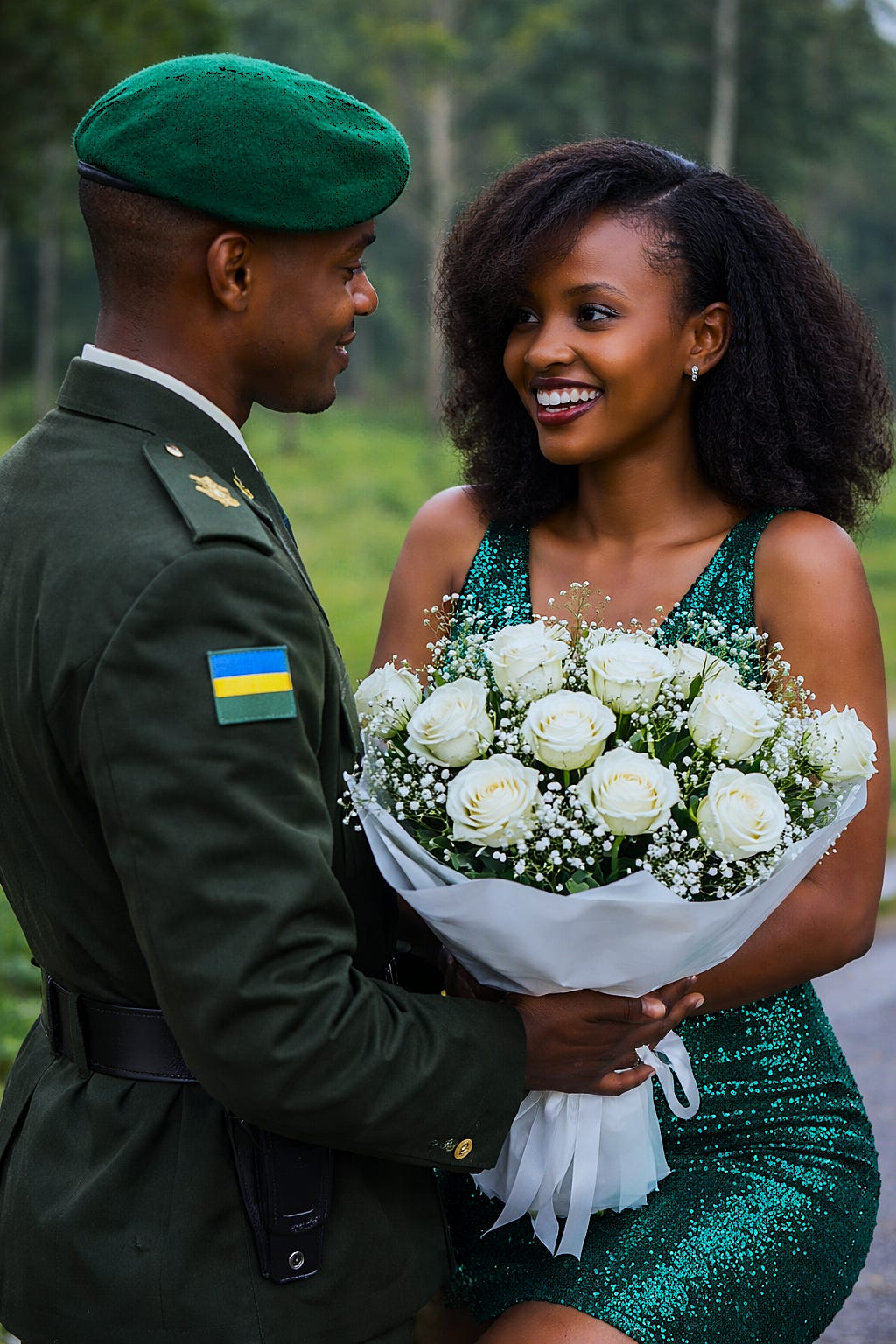
He was holding white roses; a full bouquet, wrapped in white ribbon with baby’s breath scattered through like small stars, the kind of flowers that say I thought about this, I planned this, you were worth the planning.
He looked at me in the green dress and something moved across his face; recognition and wonder and relief all at once.
He crossed the distance.
He handed me the roses without a word.
I took them. I looked up at him. My eyes were already failing me.
“Hi,” I said.
“Hi,” he said.
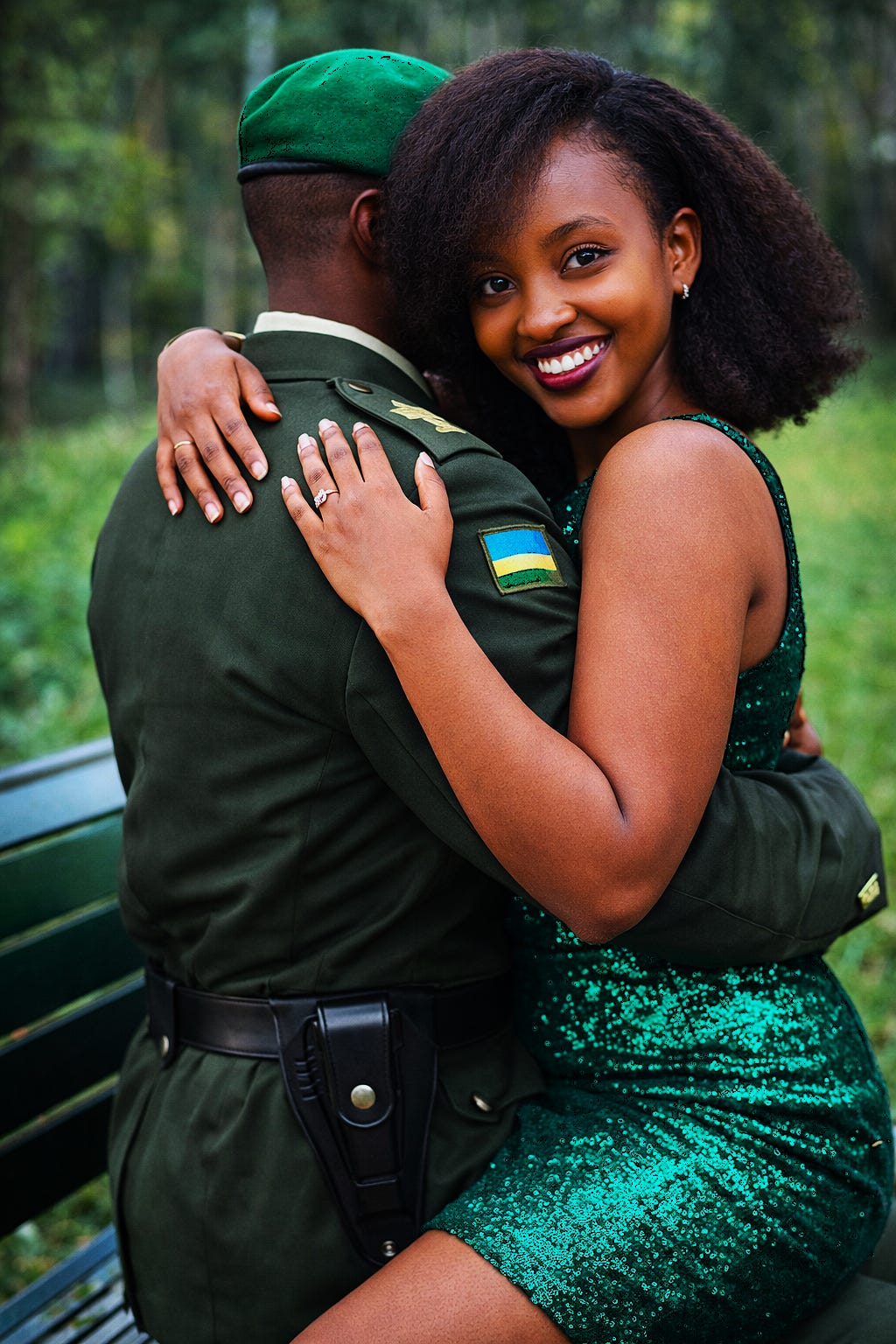
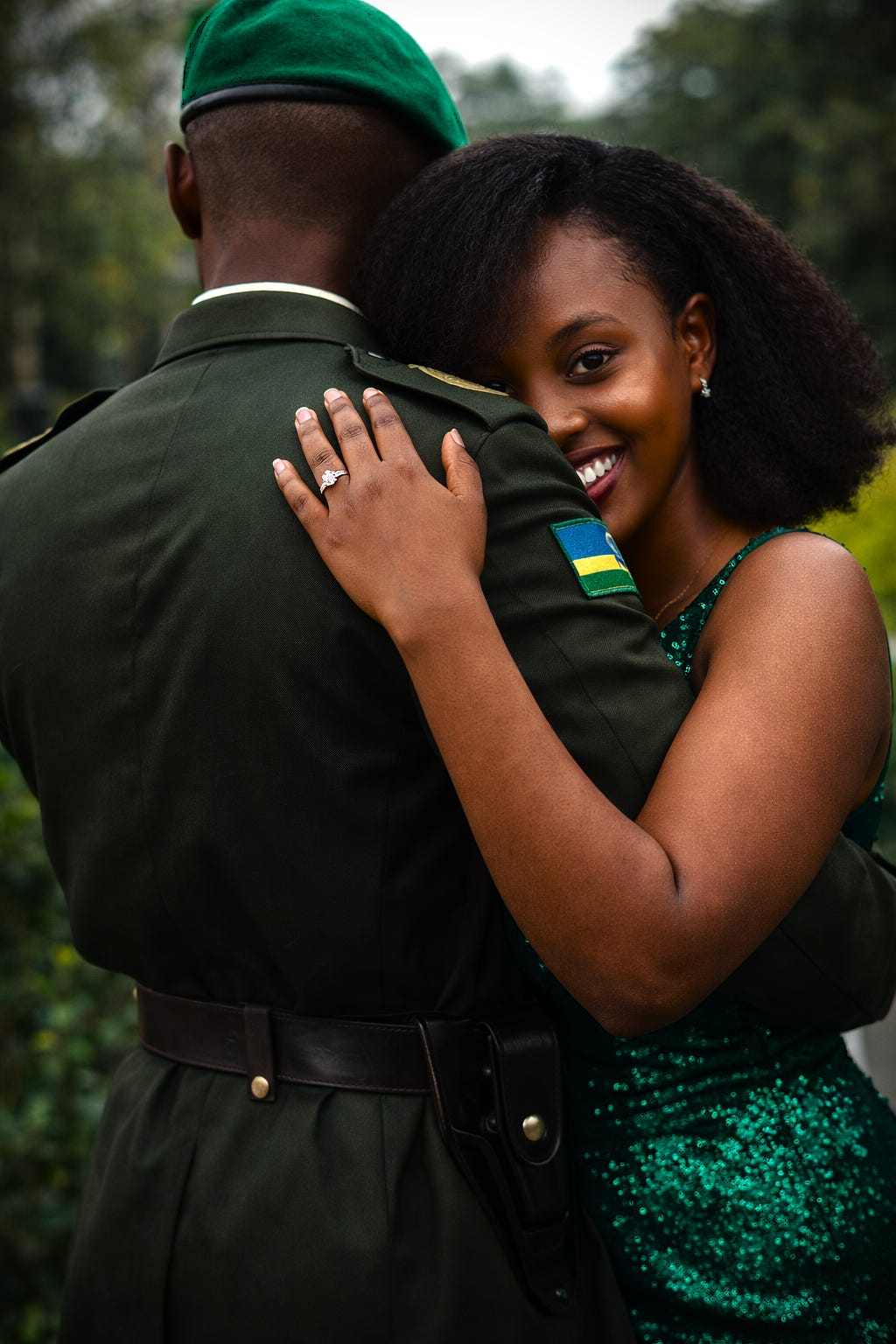
And then I was in his arms, my face pressed against the shoulder of his uniform, the Rwandan flag beneath my cheek, and he held me the way you hold something you have been careful with across a long distance; close, and steady, and with tremendous relief.
He smelled like himself.
He smelled like the boy from the library, grown into a man who knew what he wanted and had the patience and the faith to wait for the right time.
I closed my eyes.
Thank you, I said; not to him. To God. Who had been arranging this since before either of us had a name for it.
VI. The Bench, Again
We went back to campus that afternoon.
Not planned. Just; we were driving and I said can we go by the university and he said I was thinking the same thing and that was that. The easy way we had always moved together, finishing each other’s sentences, wanting the same things at the same moment.
The campus was quieter than our years there. We walked the familiar paths. Past the library; third floor, uncomfortable chairs, poor lighting. Past the faculty steps where the sun had gone down golden and everything had shifted without announcement.
We sat on the bench near the old jacaranda tree.
He was quiet for a while. Then:
“I’ve been thinking about something.”
“Tell me.”
“I’ve been thinking about the fact that you were right there.” He shook his head slowly. “Three years, Divine. Right there. Same library, same campus, same circles. I almost missed you.”
“You didn’t,” I said.
“No.” He turned to look at me. “I didn’t.” His jaw was set the way it got when he was being serious; fully serious, no deflection. “And I am done with almost. I am done with not yet and not the right time. I have loved you in silence and across distances and through every inconvenient and complicated season and I am asking God right now what I asked Him on every difficult night away; let me do this right. Let me be worthy of her.”
I was holding his hand very tightly.
“Elijah…”
“Not yet,” he said gently. “I’m going to do it properly. You deserve properly.”
I looked at him; this man who had been my friend before he was anything else, who had counted the pages I turned, who prayed like he meant it, who wrote three-page letters by hand and came home with white roses and loved me across every kind of distance.
“Okay,” I said.
“Okay,” he said.
We sat under the jacaranda until the light went gold.
VII. Properly
Three weeks later.
Full uniform. The kind of evening that holds its breath.
He took me to the garden behind the university chapel; the one where we had walked late at night during exam season, talking about God and faith and what we wanted our lives to mean. The garden that had witnessed us when we were still pretending.
There were candles. White roses again. And him, going down on one knee in his olive green uniform, the badge on his beret catching the last light, the Rwandan flag on his arm; this man who served his country and loved his God and had loved me since a library on a Thursday afternoon.
“Divine,” he said.
Just my name first. The way he always said it.
“We started as strangers who became friends who became everything. And I want to tell you that every version of us; the library version, the faculty steps version, the long-distance phone call version, the homecoming version; every single one has been my favorite. Because every version had you in it.”
He opened the box.
The ring was beautiful. Simple and brilliant and exactly right.
“I don’t want any more versions without the title to match,” he said. “Will you be my wife, Divine? Will you let me love you properly; in every season, through every deployment, in every ordinary and extraordinary moment; for the rest of our lives?”
The candles flickered.
The chapel garden held its breath.
I thought about the library. About the boy who counted my pages and asked me to sit back down. About every prayer I had prayed into silence and every letter I had kept in my Bible and every green sunrise I had watched while asking God to bring him home safely.
He was always going to be this, I thought. God knew.
“Yes,” I said, and I was laughing and crying the way you do when joy is too large for just one feeling. “Elijah. Yes.”
He stood. He slid the ring onto my finger; the hand that had held his across a hundred conversations and a thousand quiet moments, and he held my face and looked at me.
The way he had always looked at me.
Like I was worth every patient, faithful, unhurried moment of the wait.
I held the lapels of his uniform; that green I had grown to love as much as I loved the man inside it, and I pressed close and I thought:
From the library to this garden. From strangers to friends to forever.
God is so extravagantly good.
I’m Divine.
I fell in love with my friend; a soldier who walked into the same library as me and stayed, who loved me before he said so, who served his country and his God and came home to me every time.
We found each other twice: once as students, once as the people we were becoming.
Both times, it was grace.
Dieu est fidèle. God is faithful.
© S.B.Divine — All rights reserved.

Comments
Post a Comment